



Ask a developer why the last scheme overran and you will usually get a specific answer: the ground, the utilities, the main contractor, the planners.
Look across enough schemes and the specifics start to matter less than the pattern. The overrun is rarely created during construction. It is created earlier, in a series of decisions that each looked reasonable at the time, and construction is simply where the invoice arrives.
Here are the nine causes we see most often on residential schemes, and the decision that closes each one down.
1. The budget was set before the scheme was defined
The most common cause, and the least discussed, is that the number everyone is working to was produced before anyone knew what was being built.
An early appraisal needs a build cost, so one gets applied: a rate per square metre from a benchmark, or from the last scheme, or from a scheme a colleague delivered somewhere similar. That figure then travels. It goes into the land bid, the funding paper and the board approval, and by the time the design is developed enough to cost properly, the budget has stopped being an estimate and become a commitment.
Benchmarks are a legitimate tool at feasibility stage. The failure is treating a feasibility number as a target after the information improves.
The decision that prevents it: formally re-baseline the budget at the end of concept design, with the board explicitly accepting or challenging the revised figure. If the revised number cannot be accepted, that is a viability finding worth having early, while the scheme can still change.
2. The inflation allowance is set to today's rate, not the delivery period
This is the live one, and right now it is quietly dangerous.
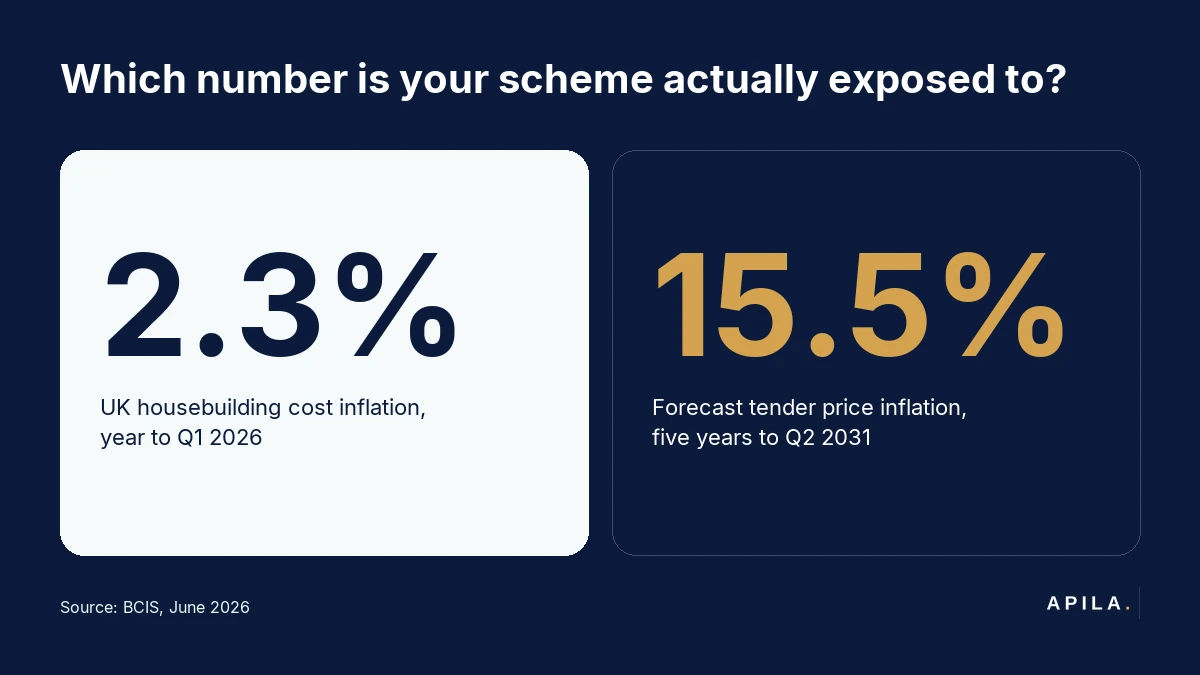
UK housebuilding cost inflation is currently modest. BCIS reported annual housebuilding cost inflation of 2.3% in the first quarter of 2026, up slightly from 2.0% the previous quarter, and far below the 15.3% peak reached in the second quarter of 2022.
A 2.3% environment feels comfortable, and a scheme appraised in that environment tends to carry a thin inflation allowance.
Now look forward instead. BCIS's five-year forecast, published in June 2026, projects building costs rising 13.1% and tender prices rising 15.5% over the five years to the second quarter of 2031. Dr David Crosthwaite, BCIS chief economist, has pointed to renewed pressure from energy and materials costs feeding through.
A residential scheme is not bought at today's rate. A site acquired now, through planning, procured next year and built over the two years after that is exposed to the forecast period, not the current quarter. Pricing multi-year delivery on a single quarter's inflation figure is one of the easiest ways to build a shortfall into an appraisal before a spade goes anywhere near the ground.
The decision that prevents it: set the inflation allowance against the actual delivery programme, using a forecast curve rather than a spot rate, and state in the appraisal which forecast has been used and when it was published. Revisit it at each gateway.
3. Ground and existing site risk surveyed too late
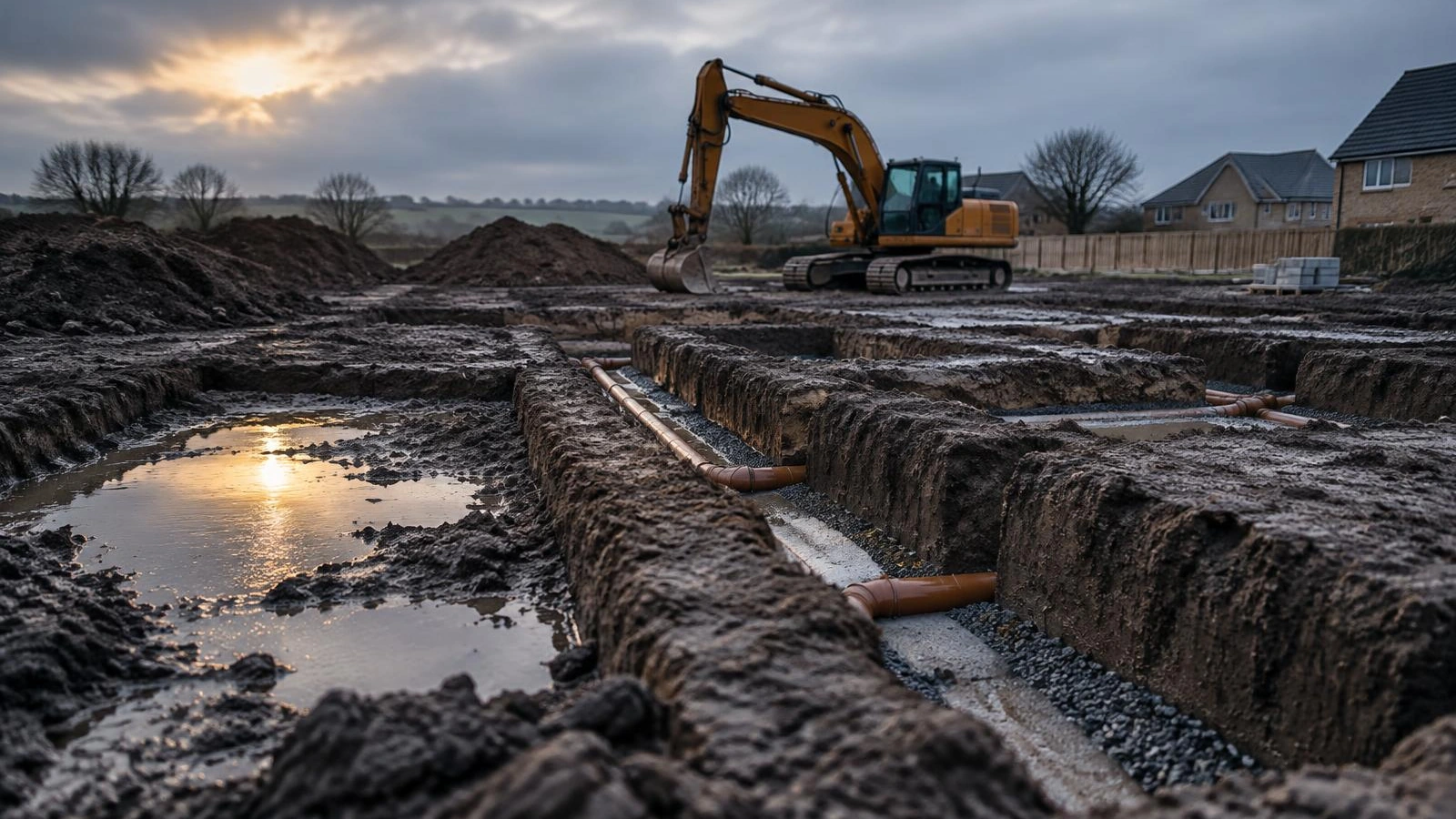
Ground conditions remain the classic residential overrun, and the reason is almost always sequencing. Intrusive investigation costs money and takes time, so it slips behind planning, and sometimes behind procurement.
By the time the information arrives, the site has been bought at a price that assumed something, the layout has been designed around assumptions, and the contractor is pricing risk they cannot see. Contamination, made ground, high water tables, unrecorded foundations and archaeology all become variations rather than design inputs.
The decision that prevents it: commission intrusive investigation before the land price is fixed where the deal structure allows, and always before design freeze. Where a vendor will not permit access pre-acquisition, price the unknown explicitly as a risk allowance rather than assuming the best case.
4. Planning obligations priced late
Section 106 contributions, affordable housing tenure and mix, biodiversity net gain, highways works and utilities reinforcement are all capable of moving a residential appraisal materially. They are also frequently unresolved when the budget is fixed, because they are negotiated in parallel with everything else.
The specific trap is treating the planning consent as the end of the cost discovery process. Conditions attached to a consent regularly carry cost that was never in the appraisal: acoustic mitigation, drainage strategies, materials upgrades, phasing restrictions on site access.
The decision that prevents it: run a formal conditions cost review immediately after consent, before the contract is let, and reconcile it against the appraisal as a distinct line rather than absorbing it into contingency.
5. Design still moving when the contract is signed
Design and build transfers design risk to the contractor, which is often the right decision on residential. What it does not do is transfer the cost of changing your mind.
When the employer's requirements are loose, or the design is genuinely incomplete at tender, the contractor prices the risk they can see and treats everything else as a variation. Each subsequent clarification arrives as a change, priced in a market of one, with no competitive tension left in it. That is the most expensive way to buy anything.
The decision that prevents it: hold the tender until the employer's requirements are genuinely complete, and resist the pressure to start on site with the design unresolved. Where a start date is immovable, price the known gaps explicitly rather than leaving them to emerge. It is also worth understanding where the employer's agent's role begins and ends on a design and build scheme, because the answer determines who is protecting your commercial position once variations start.
6. Utilities and infrastructure lead-ins
Statutory undertaker connections, substation provision, diversions and reinforcement works sit outside the main contract, run to their own timescales, and are almost impossible to accelerate with money.
On residential schemes they cause overrun in two directions at once. The direct cost is frequently underestimated at appraisal. The indirect cost is worse: a delayed connection can hold up handovers, which delays sales receipts and extends the funding period on the whole scheme.
The decision that prevents it: make formal application early, treat the lead-in as a critical path item from day one rather than a procurement task, and hold a specific risk allowance for reinforcement works until the position is confirmed in writing.
7. The procurement route does not match the risk profile
Procurement is often chosen by habit. The developer's usual route gets applied to a scheme with a different risk profile, and the mismatch shows up commercially later.
A complex site with significant unknowns procured on a lump sum with an incomplete design will produce either a heavily loaded tender price or a stream of variations, and frequently both. A simple, well-defined scheme procured on a route that keeps risk with the developer gives away the certainty that could have been bought cheaply.
The decision that prevents it: choose the route from the risk profile of the specific scheme, at the point when the risks are known and before the design team is fully instructed. This is one of the highest-value decisions on any residential project, and it is usually made too quickly.
8. Slow decisions during delivery
Once on site, the cost of a decision rises with every week it waits. Programme is being consumed, preliminaries are being incurred, and other trades are sequencing around a gap.
Research on decision delay in construction has identified client decision-making as a substantial source of delay, and has also found that the leading causes of those delays include incomplete documentation and evidence and inadequate communication. In other words, decision-makers are frequently being asked to decide without the information that would let them.
The decision that prevents it: agree the decision structure before work starts, including a variation threshold and a reporting format that presents options, cost, programme impact and a recommendation. We have written separately on what good project governance looks like.
9. Contingency without a policy
Most residential appraisals carry a contingency. Far fewer carry a policy governing it.
Without one, contingency behaves predictably. It gets drawn down early on items that were foreseeable, because it is there and the alternative conversation is uncomfortable. By the time genuinely unforeseeable events arrive, typically during construction when exposure is greatest, the contingency has been spent on things that should have been in the budget.
The decision that prevents it: write a contingency policy at the outset. Who authorises a drawdown, against what criteria, and what gets reported. Distinguish design development allowance from risk contingency, and hold a fixed percentage that cannot be released before a defined project stage.
The pattern behind the nine
Seven of these nine are decisions made before construction starts. That is the point worth taking away.
A residential scheme's cost outcome is largely determined in the period between land appraisal and contract award, which is also the period with the least visible activity and the least project management resource on it. Developers commonly appoint full-time cost and management support at the point where money starts leaving quickly, which is the point at which most of the decisions that determine the total have already been made.
Bringing experienced client-side project management into that earlier window changes the outcome more than anything that can be done once the contractor is on site.